My Lab
This, is my homelab.
...physically at least.
My collection of noisy (it's not actually that bad), room-warming, computers and network switches which provide me a place to learn and tinker.
Everything is housed in an APC 24U rack scavanged off of Facebook Marketplace; a big improvement over the slew of machines which used to be scattered around the room. A number of the servers housed physically in my rack are currently off and are not actually incorporated into my homelab. As well as maintaining my homelab, I also administer my home network (housed seperately), and a small business network. As a result, my rack has ended up as a bit of a storage shelf of sorts. However, each machine and piece of equipment that is part of my homelab, serves an important role. Regardless, here's a photo of my physical homelab rack:
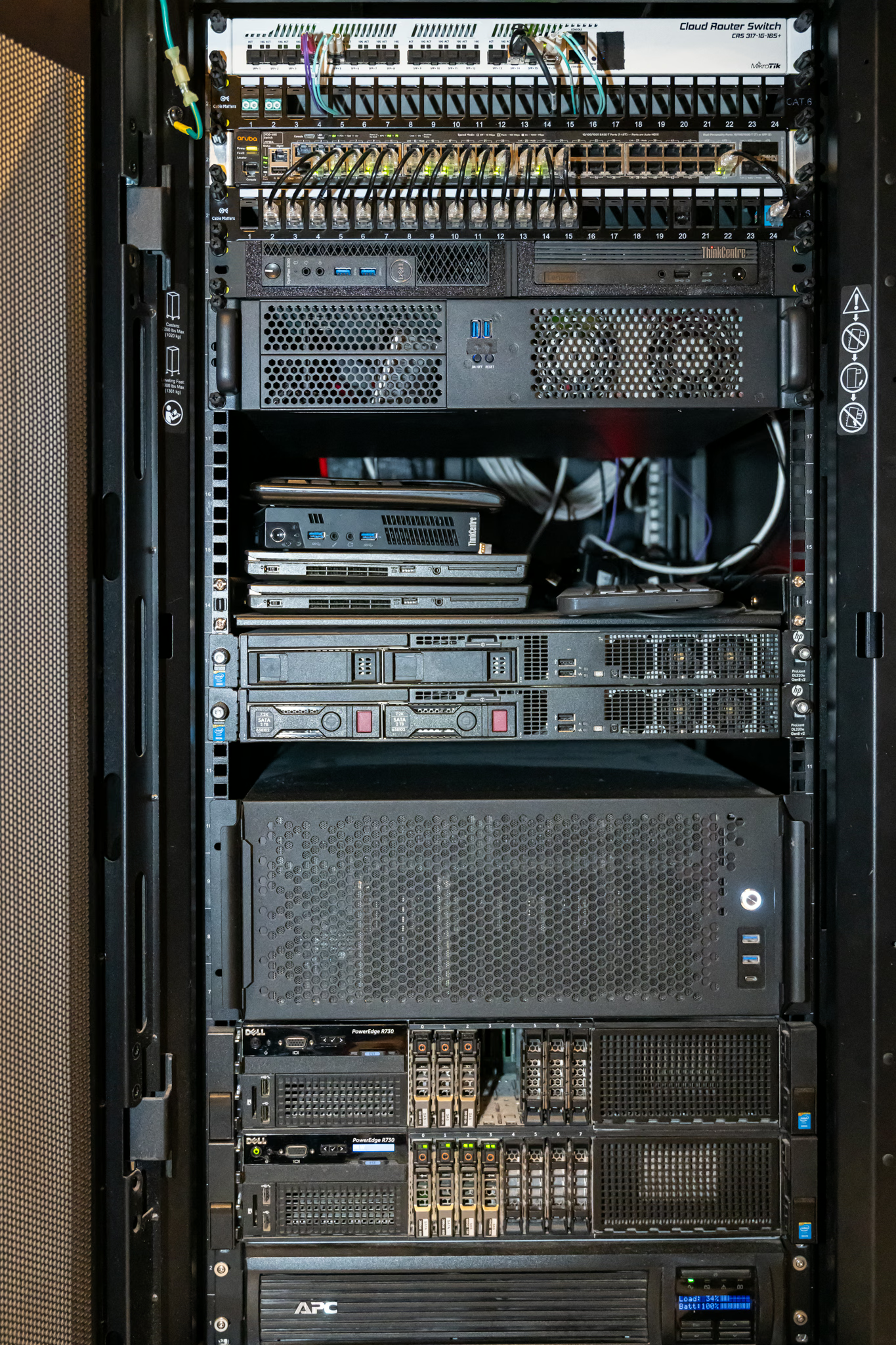
The Rack: From Top to Bottom
A hopefully helpful diagram:
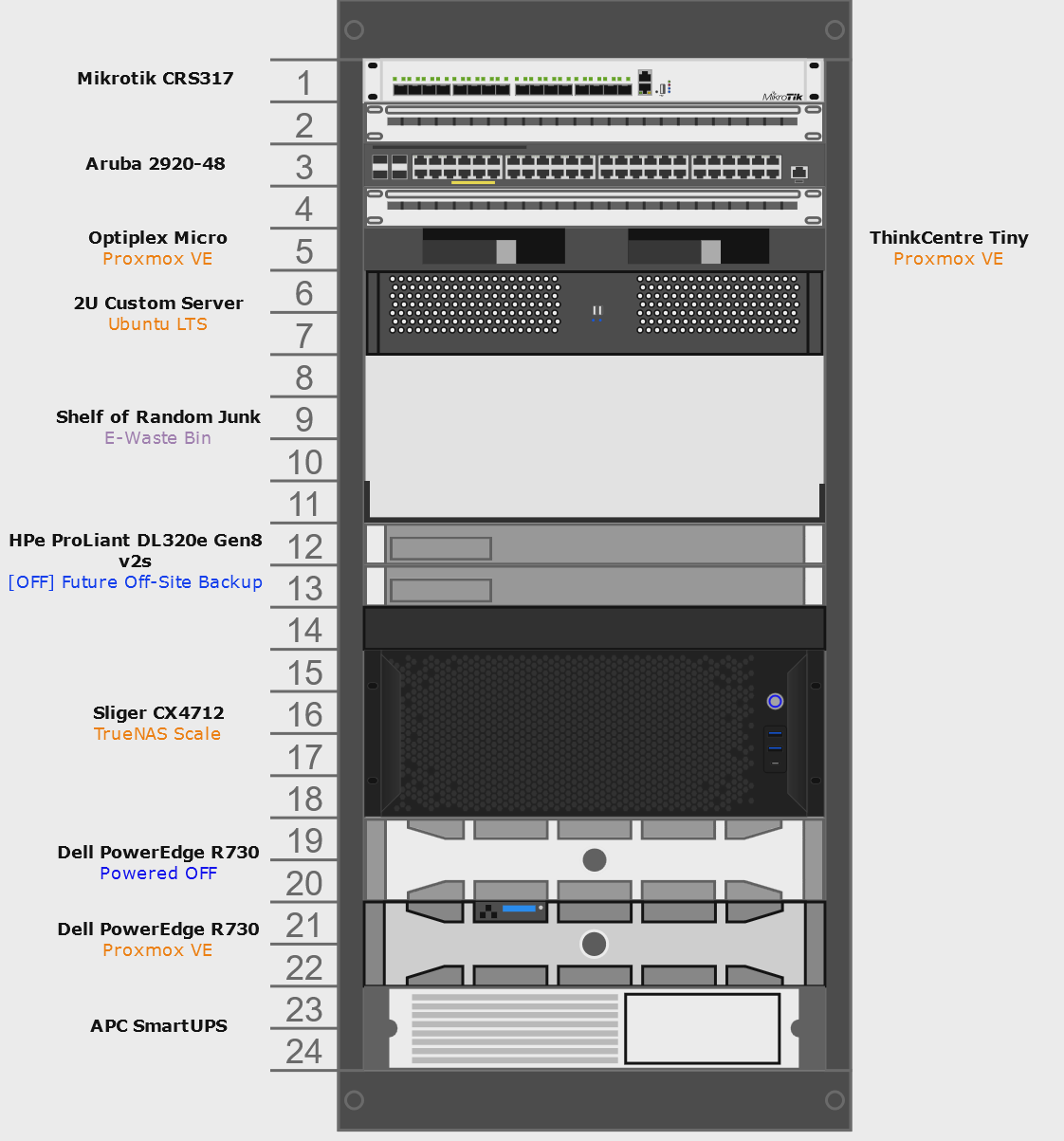
- Mikrotik CRS317 Network Switch - This is my 10GbE switch, primarily connecting my storage server with my workstation. Most of the ports are currently not populated, but there are future plans to migrate more servers to 10GbE in the future.
- Aruba 2920-48G - This is my primary 1GbE switch and is responsible for connecting the majority of machines in my rack. I initially purchased this switch with the intent on learning about Layer 3 network switches, however it has since become a home-prod switch, so I haven't had the oppurtunity to play around with that yet.
- Dell Optiplex 3060 Micro (left) - One of two Ultra SFF machines in my rack, this serves as a virtualisation host as part of my Proxmox cluster. It's equipped with an i7-8700T and 32GB of RAM. It's main purpose now is just to house a failover PiHole DNS server.
- Lenovo ThinkCenter Tiny M75q gen 2 (right) - My second Ultra SFF machines in my rack. This machine also serves as a virtualisation host as part of my Proxmox cluster. It's equipped with a Ryzen 5 4650GE and 32GB of RAM. It importantly houses a development server VM which I use for my academic courses as a remote VSCode server. In the future, both it and the Dell Optiplex Micro will hopefully house kubernetes VMs.
- Custom 2U Server - This is my dedicated Minecraft/Game server. Yes it is overkill. This was my gateway into homelabbing, although not with this particular hardware, hosting a Minecraft server propelled my interest into servers and ultimately homelabbing. It currently houses an Intel i5-12500 and 32GB of RAM. It runs Ubuntu Server on baremetal, and I use docker containers for each game server managed via Pterodactyl.
- Shelf of Junk - Although it houses my all important keyboard for diagnosing!
- Raspberry Pi (behind shelf) - This little Raspberry Pi (not visible from the above photo), serves an important job. It runs Network UPS Utility (NUT) and will, on the event of a power loss to the rack, begin shutting down all the servers safely. This ensures that hardware is not at risk of being damaged and data is safely transferred in the event of a power failure.
- HPE ProLiant DL320e Gen8 v2 x2 - These are not-yet-commissioned servers which will hopefully serve as offsite and onsite backup targets in the future. They were purchased a couple years ago with the intent of purchasing hard drives shortly after. However, that project was postponed, and with the current price of storage and RAM, I don't foresee their deployment anytime soon.
- Custom 4U Storage Server - This is my primary storage server, running TrueNAS. It serves as a NAS for files, photos, and media. As well it houses storage pools for backup of other servers, VMs, and game server data. Running everything from SMB to local S3 storage, this machine pulls a lot of weight. It's currently equipped with an AMD EPYC 7282 and 64GB of ECC RAM. Choosing an enterprise platform was important for me, as I prefer the ECC for ZFS, and the extra PCIE lanes were necessary to faciliate an HBA, GPU for media transcoding, as well as a pool of enterprise NVMe drives serving as an edit pool for my media hobbies (photo and video).
- Dell PowerEdge R730 #1 - This server currently serves no purpose. I was fortunate and privileged to receive it for free, however the power draw and noise of one make it unattractive to fire up a second.
- Dell PowerEdge R730 #2 - This server serves as my primary virtualisation host running Proxmox. It runs a multitude of VMs, most of which subsequently host Docker containers. Some examples of services which run on this machine are: this website, network management controllers, my primary Docker host for selfhosted services, and a variety of other VMs. Most importantly, this server has a large amount of resources, allowing me to spin up VMs or containers on the fly in order to test or learn new things. It currently has two Intel E5-2680v4s and 128GB of ECC RAM.
- APC UPS - This is my UPS which ensures that servers can gracefully shutdown or survive a brownout in the event of a power failure.
The Future
I expect that in short time, this page will be outdated as I swap in new hardware and try out new things. I'll hopefully keep up with updating it as I do. As for this page, for now, that's all. As I have more time to work on this site, I'll consider adding a network diagram, and a diagram outlining all the things and services I run in my lab.